
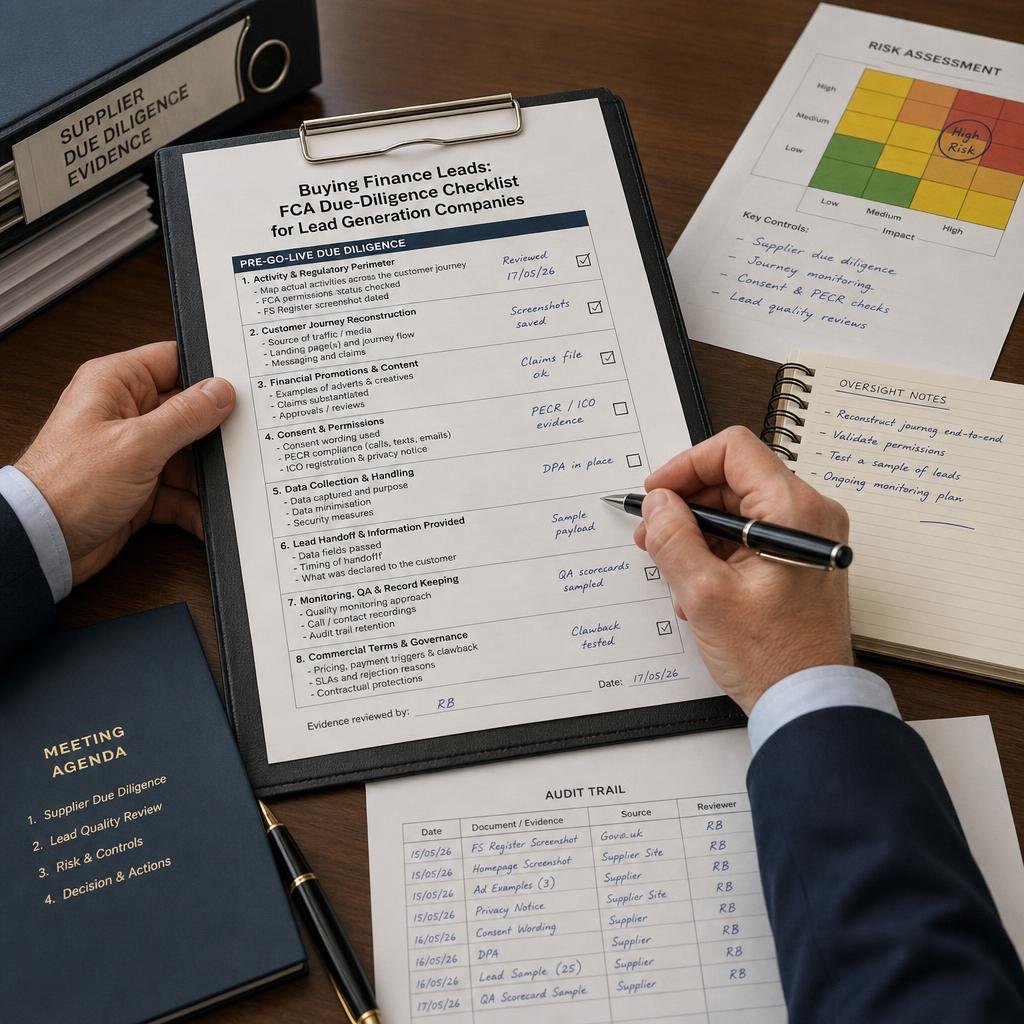
Buying finance leads can look like a simple media purchase: agree a price, set an acceptance rule and wait for enquiries to arrive. For a credit broker, however, the lead is the end product of a customer journey that has already begun. The advert, landing page, consent wording, data collection and hand-off may all affect what the customer understood and whether the resulting contact can be used lawfully.
The commercial contract matters, but it is not the due-diligence file. Before buying a single lead, a broker should be able to reconstruct how the person was attracted, what they were told, what they agreed to and what activity the supplier actually performed.
This is particularly timely after changes to the FCA's lead-generator rules in CONC 8.9 took effect on 31 July 2026. Those specific rules apply to firms accepting leads for debt counselling, debt adjusting or credit information services, not automatically to every credit-broking lead purchase. Even so, their emphasis on checking websites, advertising, commercial practices, ICO registration and PECR processes is a useful regulatory benchmark. It shows the direction of travel: a supplier invoice is not evidence that the customer journey was sound.
A business calling itself a publisher, affiliate, introducer or lead generator does not settle the regulatory perimeter. FCA guidance explains that credit broking can include introducing an individual seeking credit to a lender or to another broker, presenting or offering an agreement, or carrying out preparatory work.
The first review should map what the supplier does in practice:
Compare that activity map with the supplier's FCA status, permissions and any appointed representative relationship. Check the Financial Services Register and keep dated evidence. If the model depends on an exclusion or on genuinely passive activity, record why the facts fit it. A contract saying “unregulated introducer” cannot turn regulated activity into an unregulated one.
For the wider perimeter analysis, see our guide to whether a credit-broking business needs FCA permission.
Ask the supplier to show the complete live journey for each traffic source, device and campaign. Screenshots are useful, but a recorded walkthrough is better because disclosures can appear late, behind accordions or only after a customer has entered personal information.
The review should cover the advert, affiliate page, landing page, form, privacy information, consent statement, confirmation screen and every email, SMS or call script used before hand-off. It should be clear who is communicating, whether the firm is a broker or lender, the nature of the service, any known lender identity, what happens next and who may contact the customer.
CONC requires credit-broking promotions to be clear, fair and not misleading. Credit brokers must not blur their role with that of a lender, and the legal name and status disclosures must work in the real presentation, not merely exist in a footer that nobody sees.
Do not approve a journey only once. Paid-search copy, comparison tables and affiliate pages can change quickly. The contract should require approval before material changes and give the broker audit access to live versions.
A spreadsheet containing a timestamp and an IP address does not prove valid consent. The broker needs the wording shown to the individual, the channel covered, the organisations named or described, the purpose of the contact and the date on which the wording was used.
Current ICO guidance says organisations using bought-in lists should check their origin and accuracy and satisfy themselves that the details were collected fairly. For email, text and recorded calls, the consent normally needs to be sufficiently specific to cover the receiving business. Telephone campaigns may also require screening against the Telephone Preference Service, depending on the circumstances.
Build these checks into acceptance testing:
The buyer remains responsible for its own use of personal data. A warranty from the seller helps allocate contractual risk, but it does not supply the missing lawful basis.
Identify every promotion that generated the lead and who was responsible for it. If an unauthorised supplier communicates material on behalf of an authorised broker, confirm the lawful approval or communication route and the scope of the broker's controls.
Review the whole impression created by the promotion. Common warning signs include guaranteed or near-certain acceptance, invented urgency, unsubstantiated “best rate” claims, lender-style branding, unclear panel limitations and a prominent application button paired with a barely visible broker disclosure.
The FCA's 2026 consultation on simplifying parts of CONC 3 does not remove the current rules while policy is being considered. It also reinforces a broader point: customer understanding and evidence matter more than a compliance team collecting approved screenshots after the event.
Cheap leads are expensive when the campaign attracts people for whom the service or available products were never designed. Before launch, agree the intended audience, exclusions, geography, product type and any vulnerability considerations. Then test whether the supplier's targeting and creative match them.
Consumer Duty responsibilities depend on each firm's role and influence in the distribution chain. Firms are generally responsible for their own activities, but they also need to share relevant information and act if they identify foreseeable harm elsewhere in the chain. For a broker buying leads, that means monitoring whether a source repeatedly produces confusion, unsuitable traffic or poor outcomes, rather than treating conversion rate as the only truth worth measuring.
A proportionate onboarding file should contain:
Sub-affiliates deserve particular attention. A supplier may present a polished owned website while most traffic comes from publishers the broker has never seen. Require a current source register, approval before new sources go live and the ability to trace every lead back to its originating journey.
Onboarding is a snapshot. The useful control is a monitoring loop that connects source, customer understanding and outcome.
Track complaints, consent disputes, duplicate rates, contactability, customer confusion about broker or lender status, rejection reasons, vulnerability indicators, drop-off after key disclosures and lender feedback. Compare sources rather than blending everything into a single conversion number.
Set triggers for investigation and suspension. A lead source that converts well but generates repeated “I did not ask for this call” complaints is not high quality. It is a warning with an attractive dashboard.
Retest live journeys periodically and after any material change. Keep the evidence of what was reviewed, who approved it, what was found and what changed as a result.
Do not buy the lead unless you can answer four questions with evidence:
Buying finance leads is not inherently incompatible with good credit-broking practice. Buying a customer journey that nobody has examined is the problem. Authorised Compliance can help firms map lead-generation activity, review promotions and consent journeys, build supplier due diligence and turn lead-source monitoring into evidence that management can actually use.
This article provides general compliance information and is not legal advice. Regulatory and data-protection analysis depends on the precise activities, parties, communications and customer journey.
Check the activity, regulated route, recipient, customer explanation, applicable consent, data use and handoff evidence.
No. Affiliate, publisher, introducer and lead-generator labels do not replace analysis of the actual activity.
Check promotions, journeys, handoffs, complaints, scope and outcomes proportionately, with owners and follow-up actions.

I’m Will Hurst, and I bring 20+ years of hands-on experience across credit broking, AR/IAR oversight, lender relationships and regulated finance operations.
Learn more about my practical, FCA-focused approach
Specialist compliance support for UK credit brokers, Appointed Representatives and Introducer Appointed Representatives. We help firms build practical, FCA-aligned compliance frameworks covering customer journeys, financial promotions, AR/IAR oversight, Consumer Duty, complaints, monitoring and regulatory applications.
Services
FCA application supportAR and IAR supportCredit broker complianceWebsite and financial promotion reviewsConsumer Duty supportCompliance monitoringComplaints and customer outcome reviewsRegulatory remediation supportMeta advertising supportAuthRouteLead generators, affiliates & publishersUseful links
HomeCredit Broker ComplianceAR & IAR SupportInsightsContactPrivacy PolicyCookie PolicyComplaints ProcedureTerms of BusinessContact
Email: support@authorisedcompliance.com
Office address: Atlantic Business Centre, Atlantic Street, Broadheath, Altrincham, England, WA14 5NQ
Registered office: Atlantic Business Centre, Atlantic Street, Broadheath, Altrincham, England, WA14 5NQ
Authorised Compliance Ltd is a company incorporated in England and Wales with registered company number 15833435.
Authorised Compliance Ltd is authorised and regulated by the Financial Conduct Authority under Firm Reference Number 1025416.
Registered with the Information Commissioner’s Office under reference ZB802407.