
Consultation status and expected policy timetable checked against the FCA's CP26/23 page on 14 October 2026.
CP26/23 proposes a more targeted and proportionate Consumer Duty, including clearer distribution-chain responsibilities, reliance between firms and more focused monitoring. For credit brokers, the current Duty still applies: the practical task is to map what the broker actually controls, remove duplicated evidence and keep accountability tied to customer outcomes.The FCA consulted on changes intended to make the Consumer Duty clearer and more proportionate. For credit brokers, that does not mean the Duty has been switched off, softened into a checklist or replaced by a general instruction to do less.
CP26/23 is a consultation. Its proposed rule and guidance changes are not current requirements. The existing Consumer Duty remains in force while the FCA considers responses. Consultation status checked on 14 October 2026: the consultation closed on 18 September 2026. The FCA expects a policy statement and any new rules in Q1 2027; that expectation is not a confirmed commencement date.
The practical opportunity for credit brokers is more useful than a headline about deregulation. The FCA is asking whether firms can focus more tightly on the parts of a distribution chain they actually control and influence, reduce duplicated work and still evidence good retail customer outcomes.
The current Consumer Duty is built around the Consumer Principle that a firm must act to deliver good outcomes for retail customers, supported by three cross-cutting rules and four outcomes covering products and services, price and value, consumer understanding and consumer support.
The FCA's current information for firms also makes clear that proportionality is already part of the framework. What is reasonable depends on factors including the nature of the product or service, customer characteristics, the firm's relationship with customers and its size. A small credit broker is not expected to reproduce the systems of a major bank, but it is still expected to understand the outcomes it can influence and to have evidence for its approach.
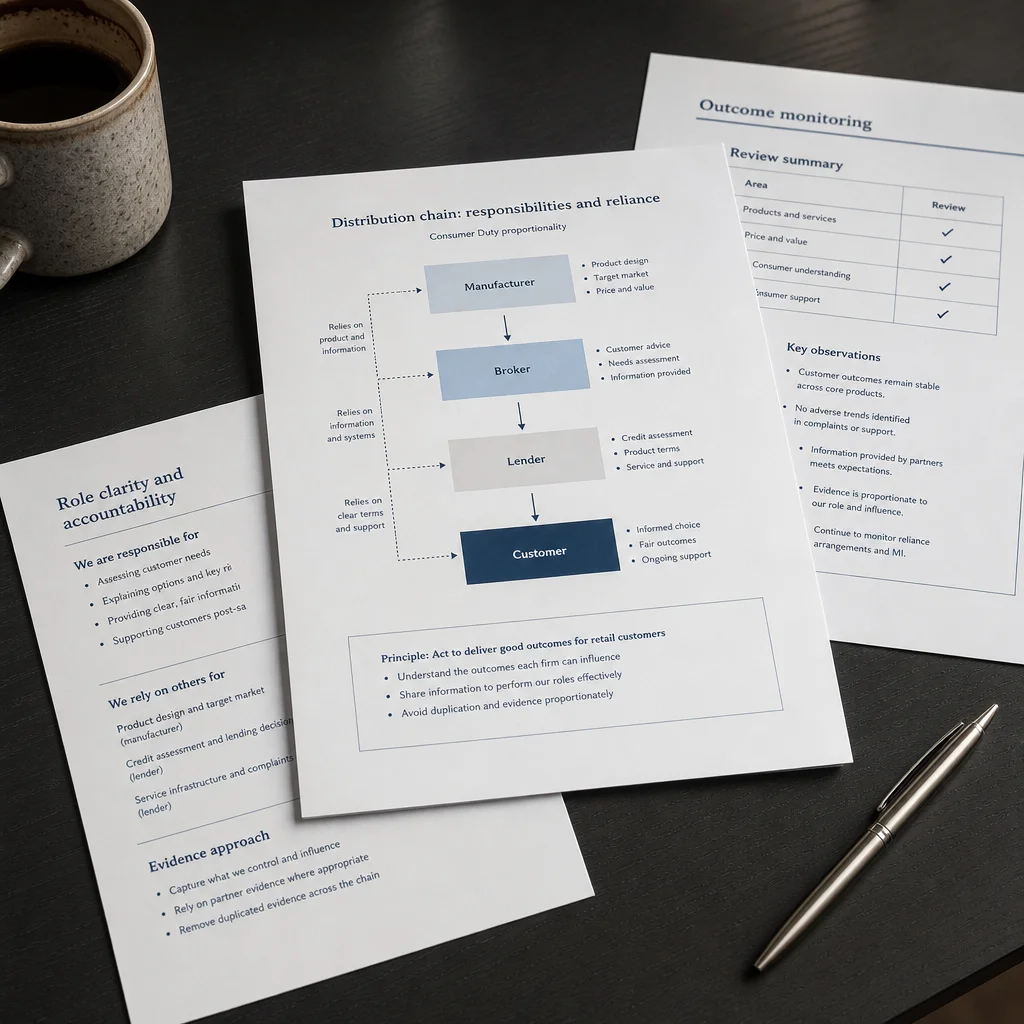
Distribution chains matter particularly to brokers. The FCA currently says the Duty applies to firms with a key role in delivering retail customer outcomes, including firms without a direct customer relationship where they can determine or influence product design or operation, communications or customer support. Manufacturers and distributors also need to share information so each can perform its own role effectively.
Those are current expectations. They should not be set aside because a consultation has closed.
The consultation is a targeted package rather than a rewrite of the Consumer Duty. The FCA says its core objective of good retail customer outcomes remains unchanged, but it has seen the Duty applied more widely and more intensively than intended in some areas, particularly wholesale markets and complex distribution chains.
Four proposed changes are central:
The FCA also proposes revised non-Handbook guidance and technical clarifications. If adopted, the updated guidance would replace FG22/5.
Again, these are proposals. Firms should distinguish them from the Handbook rules and guidance that apply now.
| Area | Current position | CP26/23 proposal |
|---|---|---|
| Consumer Duty | Current rules remain in force where applicable. | Proposed scope and proportionality changes await final policy. |
| Distribution responsibilities | Identify the firm's role, influence and relevant duties across the journey. | Clarify responsibilities and proportionate reliance between firms. |
| Monitoring and reporting | Continue applicable outcome monitoring and governing-body assessment. | More focused and proportionate expectations are proposed. |
| Timing | No entitlement to stop current controls because a consultation has closed. | Policy statement and any rules expected in Q1 2027; commencement must be checked separately. |
Credit broking is often a chain rather than a single customer relationship. A journey can involve an affiliate or publisher, a broker, a lender or lender panel, technology providers and sometimes other intermediaries. The broker may control the advert and landing page but not the lender's underwriting. It may choose a lender panel but not design the credit product. It may receive outcome data but not own every post-sale interaction.
That division of responsibility is exactly why proportionality matters. A broker should not be expected to recreate a lender's control framework merely because both firms touch the same journey. Equally, a broker cannot outsource responsibility for the things it actually controls.
If a broker writes the promotion, captures the lead, explains its role, chooses where the enquiry is sent and handles the initial customer contact, those activities can materially influence understanding and outcomes. Calling the lender the 'manufacturer' does not make the broker's own communications somebody else's problem.
The useful question is therefore not, 'Can we do less Consumer Duty work?' It is, 'Can we show which outcomes we influence, what evidence we need for those outcomes and where another firm's evidence can reasonably be relied upon?'
CP26/23 says the FCA wants more reliance among parties in a distribution chain and less duplication. That could be valuable for brokers that currently request large evidence packs from lenders or partners without a clear explanation of how every document informs a decision.
But reliance needs structure. A proportionate framework might identify who owns each part of the customer journey, what information is needed from another firm, how often it is refreshed, what would trigger challenge and what happens when the evidence points to harm.
For example, a broker may reasonably rely on a lender for information about product design or aspects of fair-value assessment that sit with the lender. The broker still needs to consider whether its own distribution strategy, customer communications and hand-offs are consistent with the target market and whether its own data reveals poor outcomes.
That is different from collecting a policy once a year and treating the existence of the PDF as assurance.
The consultation proposes greater clarity that firms should focus monitoring on activities for which they are responsible. For smaller credit brokers, that could support a more useful evidence set.
Rather than producing a large dashboard because the phrase 'Consumer Duty MI' sounds reassuring, a broker can ask what its data actually proves. Relevant measures might include customer confusion about broker versus lender status, complaint themes by lead source, consent disputes, failed or abandoned journeys, vulnerable-customer indicators, lender rejection patterns, repeat applications, contact-channel issues and outcomes by introducer or affiliate.
The FCA's current July 2026 outcomes-monitoring material reinforces the underlying point: firms need to assess, test, understand and evidence the outcomes customers are receiving. A future clarification on proportionality would not turn evidence into an optional extra. It may make the evidence more tightly connected to responsibility.
Current rules require a firm's board or equivalent governing body to review and approve an assessment of retail customer outcomes at least annually. CP26/23 proposes targeted adjustments intended to make board reporting more proportionate and focused on the firm's responsibilities.
For a small broker, this should be read as an argument for a better report, not necessarily a longer one. Senior management should be able to see where poor outcomes occurred, which customer groups were affected, the root cause, what changed and whether the remediation worked.
A board pack that contains dozens of green metrics but cannot explain a recurring complaint theme is not made stronger by its page count.
There is no need to redesign a Consumer Duty framework around rules that have not been made. There is, however, a useful review firms can do now.
The consultation response deadline has passed. Retain practical evidence about duplicated work, unclear responsibility and information-sharing friction so any final policy can be assessed against the firm's actual journey and control framework.
The most important line in CP26/23 is that the FCA's core objective of delivering good outcomes for retail customers remains unchanged. The consultation is about making the Duty more targeted, proportionate and predictable.
For credit brokers, that should encourage a move away from compliance theatre. A smaller evidence pack can be stronger if every measure is connected to a customer journey, a responsibility, a risk and an action. Reliance on another firm can be sensible if the boundary is understood and the evidence is credible. Fewer duplicated controls can improve oversight if accountability becomes clearer rather than weaker.
Until final rules are made, the current Duty continues to apply. The job now is to understand the proposals, test whether existing Consumer Duty work is genuinely useful and be ready to adapt once the FCA publishes its final position.
Authorised Compliance helps credit brokers map Consumer Duty responsibilities across customer journeys, distribution partners and monitoring frameworks so that evidence is proportionate, practical and tied to the outcomes the firm can influence.
This article provides general compliance information and is not legal advice. CP26/23 is a consultation and its proposals may change before any final rules or guidance are made.
Sources:
No. The consultation closed on 18 September 2026.
No. Current applicable Consumer Duty rules remain in force.
No. It is the FCA's expected timing for a policy statement and any rules. Check final commencement separately.

I’m Will Hurst, and I bring 20+ years of hands-on experience across credit broking, AR/IAR oversight, lender relationships and regulated finance operations.
Learn more about my practical, FCA-focused approach
Specialist compliance support for UK credit brokers, Appointed Representatives and Introducer Appointed Representatives. We help firms build practical, FCA-aligned compliance frameworks covering customer journeys, financial promotions, AR/IAR oversight, Consumer Duty, complaints, monitoring and regulatory applications.
Services
FCA application supportAR and IAR supportCredit broker complianceWebsite and financial promotion reviewsConsumer Duty supportCompliance monitoringComplaints and customer outcome reviewsRegulatory remediation supportMeta advertising supportAuthRouteLead generators, affiliates & publishersUseful links
HomeCredit Broker ComplianceAR & IAR SupportInsightsContactPrivacy PolicyCookie PolicyComplaints ProcedureTerms of BusinessContact
Email: support@authorisedcompliance.com
Office address: Atlantic Business Centre, Atlantic Street, Broadheath, Altrincham, England, WA14 5NQ
Registered office: Atlantic Business Centre, Atlantic Street, Broadheath, Altrincham, England, WA14 5NQ
Authorised Compliance Ltd is a company incorporated in England and Wales with registered company number 15833435.
Authorised Compliance Ltd is authorised and regulated by the Financial Conduct Authority under Firm Reference Number 1025416.
Registered with the Information Commissioner’s Office under reference ZB802407.