
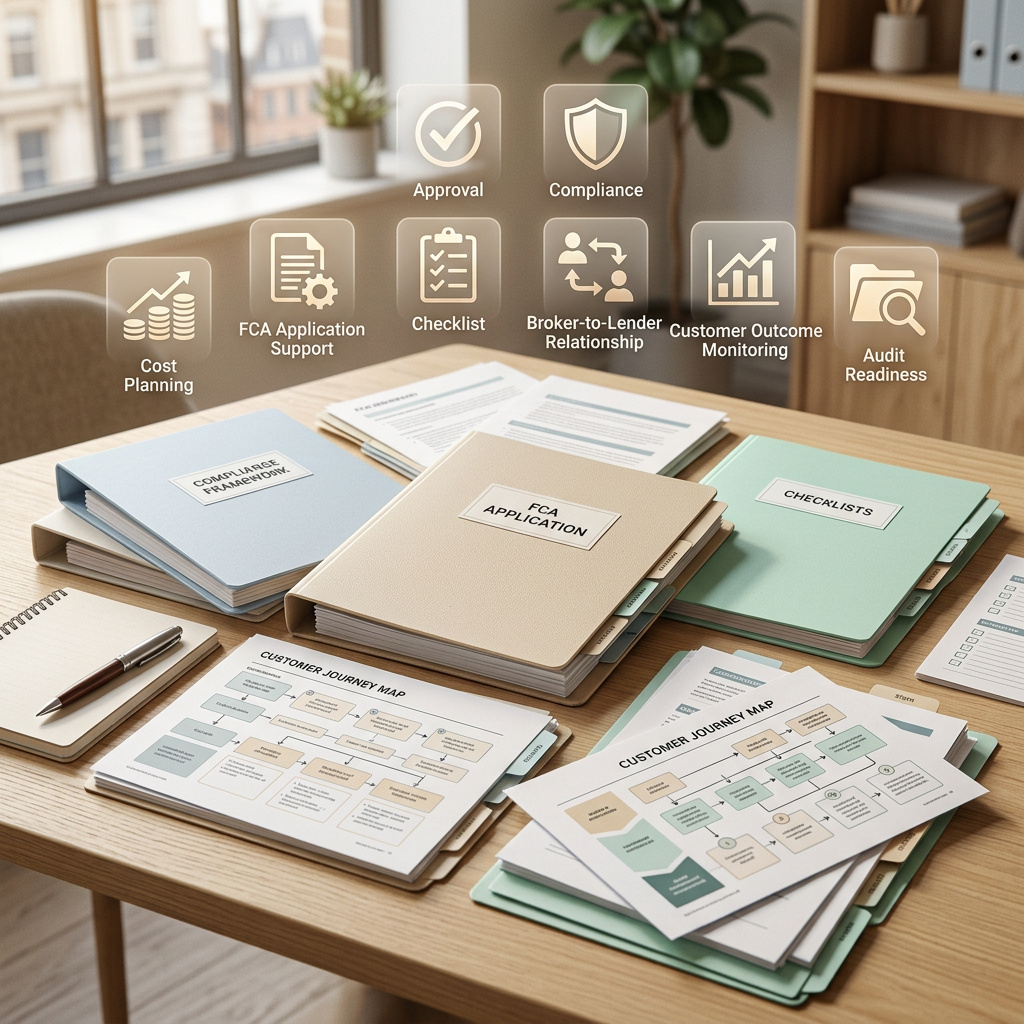
The cost of becoming an FCA authorised credit broker depends on the business model, permissions needed, complexity of the customer journey and level of support required.
There is no single fixed cost that applies to every credit broking business. A simple model with a clear customer journey and limited activity may be easier to prepare than a business with multiple lead sources, lender relationships, introducers, complex financial promotions or higher-risk customer journeys.
The total cost may include FCA application fees, compliance consultancy support, business plan preparation, policies, financial promotion reviews, customer journey testing, staff training and ongoing compliance monitoring.
This guide explains the main cost areas to consider when planning to become an FCA authorised credit broker.
Credit broking businesses do not all operate in the same way.
A firm may be:
Each model creates different compliance work.
A business with a simple, well-documented journey may need less preparation than one with several marketing channels, multiple customer handoffs and third-party introducers.
For a broader overview, read What Is Credit Broking Compliance? A Beginner’s Guide.
The cost of becoming an FCA authorised credit broker usually includes more than the FCA application fee.
The main areas are:
Some firms may also need legal advice, data protection support, website changes, lead generation reviews, lender relationship support or outsourced compliance support.
Application fees checked against the FCA's fee categories on 14 October 2026:
| Application category | FCA application fee |
|---|---|
| Category 2: limited consumer credit permission | £560 |
| Category 3: straightforward consumer credit application | £1,130 |
| Category 5: moderately complex consumer credit application | £5,640 |
| Category 6: complex consumer credit application | £11,260 |
Confirm the applicable category and any special treatment before budgeting. Full-permission applications do not all fall in Category 3. These are regulator application fees, not total setup costs or Authorised Compliance prices.
The FCA charges application fees for authorisation. The amount depends on the application category and the nature of the permissions being requested.
For consumer credit firms, the correct fee category can depend on whether the firm is applying for limited permission or full permission and the regulated activities involved.
Because FCA fees can change, firms should check the latest FCA fee information before budgeting or submitting an application.
The FCA also provides guidance on applying to become a consumer credit broker and the information it expects to see in an application.
For more on the application process, read How to Get FCA Authorisation as a Credit Broker: Step-by-Step Guide.
The type of permission needed can affect both application cost and preparation work.
Some consumer credit firms may fall under limited permission. Others require full permission.
The right route depends on the activity carried out, not simply on which option is cheaper.
A firm should review:
A cheaper route that does not fit the activity can create greater cost later through delays, remediation or regulatory risk.
For route options, read Choosing an FCA regulatory route for your credit broking firm.
Many firms use specialist compliance support to prepare the application and supporting framework.
Compliance consultancy costs may depend on:
A low-cost application service may not include the practical framework needed to operate after authorisation.
The right question is not only “what does the application cost?” but “what support do we need to build a controlled credit broking business?”
For help choosing support, read Choosing the Right FCA Compliance Consultant for Your Credit Broking Business.
An FCA application usually requires a clear explanation of the firm’s business model.
The business plan should explain:
Costs can increase if the model is not clear before the application work starts.
A strong business plan should be specific to the firm, not a generic template.
A credit broker will usually need policies and procedures that support its regulated activity.
These may include:
The cost will depend on whether the firm already has suitable documents or needs them created from scratch.
Policies should match the real business model. A generic policy pack may be cheaper at the start but can create problems if it does not reflect the actual customer journey.
For a practical overview, read Credit Broking Compliance Checklist: What You Need to Know.
A customer journey review is one of the most important parts of preparing for authorisation.
The review may cover:
The aim is to make sure customers understand who they are dealing with, what service is being provided and what happens after they submit an enquiry.
Costs can increase if the journey is unclear, inconsistent or spread across multiple channels.
For related guidance, read Credit Broker vs Lender: Key Differences Explained.
Financial promotions can be a major preparation area for credit brokers.
A review may include:
The cost will depend on the volume of promotions, number of channels and complexity of claims being made.
Promotions should be clear, fair and not misleading. They should make the broker role clear where relevant and avoid claims that are difficult to evidence, such as guaranteed approval or whole-of-market access unless properly supported.
For more detail, read How to Advertise as a Credit Broker Without Breaking FCA Rules.
Consumer Duty should be considered as part of the application and operating framework.
Costs may include work on:
The aim is to show that the firm has considered customer outcomes, not just created policies.
For firms with complex lead generation models or vulnerable customer risks, this work may be more detailed.
For related guidance, read Understanding the Affordability and Suitability Rules in Credit Broking.
Some firms discover during the authorisation preparation process that their website, landing pages or adverts need changes.
This can create additional cost for:
These costs are not always part of compliance consultancy fees, but they may be needed to make the business model clearer and more controlled.
A credit broker should be able to keep evidence of compliance activity.
Systems and record keeping may include:
This does not always require expensive software from day one, but the firm needs a controlled way to keep records and retrieve evidence.
For audit preparation, read Credit broker compliance audits: what to expect.
Staff should understand the firm’s credit broking model and compliance obligations.
Training may cover:
Training may be delivered internally, by a compliance consultant, through online training or as part of outsourced compliance support.
Training should also be refreshed when the business model changes.
Becoming authorised is not the end of the cost.
After authorisation, the firm will need ongoing compliance controls. These may include:
Firms should budget for ongoing compliance before applying. A business that can afford authorisation but not ongoing monitoring may struggle later.
For more detail, read How Much Does It Cost to Maintain FCA Compliance for Credit Brokers?.
Some firms may not need direct FCA authorisation if Appointed Representative or Introducer Appointed Representative status is more suitable.
AR or IAR status may involve different costs, such as:
AR and IAR status should not be judged only by cost. The route must fit the business model and the activity the firm intends to carry out.
An IAR arrangement is more limited than full AR status and may only be suitable for introductions or distributing approved financial promotions.
For firms considering this route, the key question is whether the arrangement gives the right level of permission, oversight and commercial flexibility.
Some costs are easy to miss during planning.
These can include:
The best way to reduce unexpected cost is to assess the business model early and prepare properly before submission.
Some costs can be managed with good preparation.
Ways to reduce avoidable cost include:
The aim should not be to make the application as cheap as possible. It should be to make the route clear, controlled and proportionate.
Common mistakes include:
For related risks, read Common Compliance Mistakes Credit Brokers Make and How to Avoid Them.
Authorised Compliance supports UK credit brokers with FCA applications, route assessment and ongoing compliance planning.
Our support can include:
We help firms understand the likely work involved and build a compliance framework that fits the business model.
You can read more in How Authorised Compliance Helps Credit Brokers Stay FCA-Compliant.
The cost varies depending on the permission type, FCA application fee, business model complexity, compliance support needed, policy work, financial promotion reviews, customer journey testing and ongoing compliance requirements.
No. Firms should also budget for compliance support, business plan preparation, policies, customer journey review, financial promotion checks, training, systems, monitoring and ongoing compliance after authorisation.
It may be cheaper in some cases, but cost should not be the only factor. AR and IAR status must fit the business model and involve ongoing oversight, controls and monitoring.
Costs are affected by the permissions required, business model complexity, number of lead sources, lender relationships, financial promotions, customer journey, Consumer Duty work and level of external support needed.
Templates may help as a starting point, but policies should match the actual business model, customer journey, lender relationships, marketing activity and compliance risks.
Yes. Ongoing costs may include annual FCA fees and levies, monitoring, financial promotion reviews, training, complaints oversight, Consumer Duty reporting, audits and outsourced compliance support.
Yes. Poor preparation can lead to delays, FCA questions, website changes, promotion rewrites, remediation work and additional consultancy time.
Yes. Authorised Compliance can review the business model, assess the route to market and help identify the application and compliance work likely to be needed.
The cost of becoming an FCA authorised credit broker depends on more than the application fee.
Firms should budget for the full route to market: permissions analysis, business planning, policies, customer journey work, financial promotion review, Consumer Duty evidence and ongoing compliance after approval.
A well-prepared application may require more work upfront, but it can reduce delays, avoid poor-fit permissions and give the business a stronger foundation for controlled growth.
Check the current requirements against the activity, customer, agreement and permissions of the particular firm. These primary sources support a scope and control review; a generic checklist does not establish compliance in every model.
Discuss your credit broking application and preparation budget. Confirm the work included, exclusions and fees before commissioning support.

I’m Will Hurst, and I bring 20+ years of hands-on experience across credit broking, AR/IAR oversight, lender relationships and regulated finance operations.
Learn more about my practical, FCA-focused approach
Specialist compliance support for UK credit brokers, Appointed Representatives and Introducer Appointed Representatives. We help firms build practical, FCA-aligned compliance frameworks covering customer journeys, financial promotions, AR/IAR oversight, Consumer Duty, complaints, monitoring and regulatory applications.
Services
FCA application supportAR and IAR supportCredit broker complianceWebsite and financial promotion reviewsConsumer Duty supportCompliance monitoringComplaints and customer outcome reviewsRegulatory remediation supportMeta advertising supportAuthRouteLead generators, affiliates & publishersUseful links
HomeCredit Broker ComplianceAR & IAR SupportInsightsContactPrivacy PolicyCookie PolicyComplaints ProcedureTerms of BusinessContact
Email: support@authorisedcompliance.com
Office address: Atlantic Business Centre, Atlantic Street, Broadheath, Altrincham, England, WA14 5NQ
Registered office: Atlantic Business Centre, Atlantic Street, Broadheath, Altrincham, England, WA14 5NQ
Authorised Compliance Ltd is a company incorporated in England and Wales with registered company number 15833435.
Authorised Compliance Ltd is authorised and regulated by the Financial Conduct Authority under Firm Reference Number 1025416.
Registered with the Information Commissioner’s Office under reference ZB802407.