
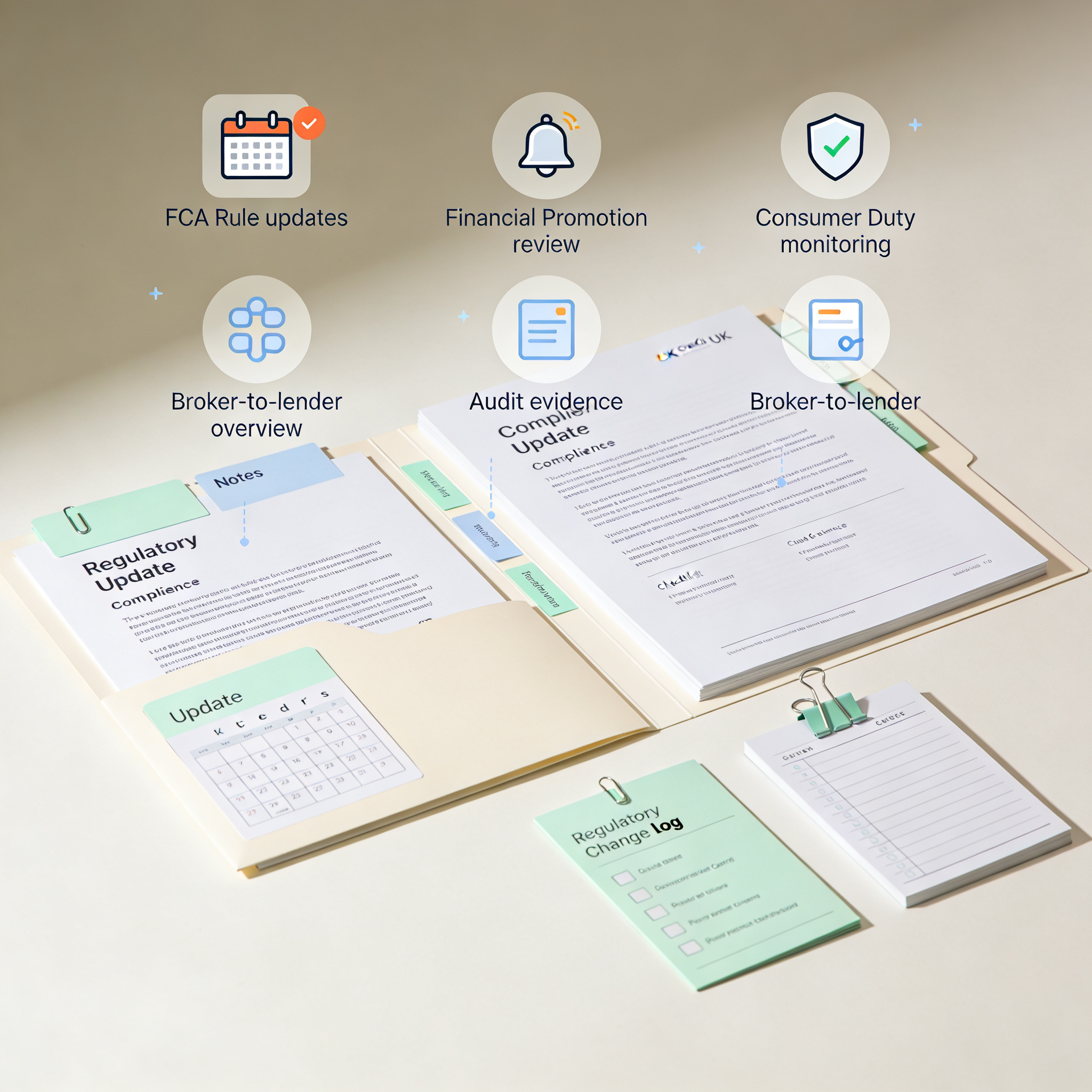
Staying up to date with FCA rules is an ongoing responsibility for credit brokers.
Credit broking compliance does not stand still. Rules, guidance, FCA expectations, reporting requirements, Consumer Duty practice, financial promotion standards and market risks can all change over time.
For UK credit brokers, the aim is not only to know that a change has happened. The aim is to understand whether it affects the business model, customer journey, financial promotions, lender relationships, complaints process, AR or IAR arrangements, monitoring plan or customer outcome evidence.
This guide explains how credit brokers can stay up to date with FCA rules and build regulatory change into day-to-day compliance.
Credit brokers operate in a regulated market. A firm may be directly authorised, operating as an Appointed Representative, acting as an Introducer Appointed Representative or preparing an FCA application.
In each case, the business needs to understand the rules and expectations that apply to its activity.
Staying up to date helps firms:
For a broader compliance overview, read What Is Credit Broking Compliance? A Beginner’s Guide.
The FCA Handbook is the main source of FCA rules and guidance.
Credit brokers should know which parts of the Handbook are relevant to their business. This may include sections covering consumer credit, financial promotions, complaints, systems and controls, Consumer Duty, conduct standards and reporting.
Important areas may include:
A firm does not need to read the whole Handbook every week. It does need a practical process for identifying changes that affect its activity.
The FCA Handbook allows users to review current rules and recent changes, and firms should use it as a primary reference point.
The FCA publishes pages specifically for credit brokers and consumer credit firms.
These can include guidance on:
The FCA’s credit broking rules page is useful, but it also makes clear that summaries are not a full list of applicable rules. Firms should still check the relevant parts of the Handbook.
For application-related guidance, read How to Get FCA Authorisation as a Credit Broker: Step-by-Step Guide.
Regulatory reporting can change over time.
Credit brokers should check whether they have reporting obligations and whether any new returns, data fields or submission requirements apply to their permissions.
Reporting changes may affect:
The FCA has published information on consumer credit reporting and policy material on consumer credit regulatory returns for firms carrying out activities including credit broking. Credit brokers should monitor these updates where relevant.
For firms that are already authorised, staying current with reporting is part of maintaining a controlled compliance framework.
Consumer Duty is a major area of ongoing FCA focus.
Credit brokers should monitor FCA publications on Consumer Duty, including good and poor practice, speeches, reviews and sector-specific expectations.
For credit brokers, Consumer Duty updates may affect:
The FCA says Consumer Duty sets higher and clearer standards of consumer protection and requires firms to put customers’ needs first.
For credit brokers, this means regulatory change monitoring should not be limited to technical rule changes. It should also include changes in FCA expectations around outcomes and evidence.
For related content, read Understanding the Affordability and Suitability Rules in Credit Broking.
Financial promotions are one of the most important areas for credit brokers to monitor.
Rules and expectations around advertising, disclosures, customer understanding and misleading claims can change. Even where the rule itself has not changed, FCA focus or market practice may shift.
Credit brokers should review:
When FCA guidance or expectations change, the firm should check whether live promotions remain appropriate.
For practical guidance, read How to Advertise as a Credit Broker Without Breaking FCA Rules.
Appointed Representative and Introducer Appointed Representative arrangements require clear oversight and monitoring.
Credit brokers operating under AR or IAR status should stay up to date with changes affecting:
AR and IAR status should not be treated as a static arrangement. If the business changes, or if FCA expectations around principal oversight change, the framework may need to be reviewed.
For route-to-market context, read Advanced Strategies for Mastering What Are the Two Types of FCA Authorisation for Firms.
A compliance calendar helps make regulatory updates manageable.
A credit broker’s calendar may include:
The calendar should be owned by someone responsible for compliance. It should also be reviewed when the business changes.
For ongoing cost planning, read How Much Does It Cost to Maintain FCA Compliance for Credit Brokers?.
Staying up to date should not be informal.
The firm should decide who is responsible for:
In smaller firms, this may be one person with external compliance support. In larger firms, it may involve compliance, marketing, operations, senior management and board-level oversight.
The important point is that responsibility should be clear.
A regulatory change log helps show that the firm is monitoring updates and acting on them.
The log can record:
This does not need to be overcomplicated, but it should be consistent.
A change log can be useful during FCA reviews, principal oversight, lender due diligence or internal audits.
Policies should be updated when rules, guidance or business activity changes.
Credit brokers should review policies covering:
A policy that is reviewed annually but not updated after a relevant change may quickly become out of date.
For a practical framework, read Credit Broking Compliance Checklist: What You Need to Know.
Regulatory updates should be translated into staff training where relevant.
Training may need updating when there are changes to:
Training records should show who was trained, when, on what topic and whether any follow-up was needed.
A rule change has limited practical value if staff do not understand how it affects their work.
Many FCA updates affect the customer journey, even if they do not directly mention website copy or forms.
After a relevant update, credit brokers should review:
The key question is whether the customer still receives clear, timely and accurate information.
For customer journey and lead generation considerations, read Lead Generation in FCA-Compliant Credit Broking: What You Need to Know.
Staying up to date is not only about external FCA updates.
Internal business changes can create compliance obligations too.
Review compliance when the firm adds:
A business can become non-compliant even if the rules have not changed. The risk can arise because the business model has moved on but the compliance framework has not.
For operational impact, read How FCA Broker Requirements Impact Your Business Operations.
Complaints and customer feedback can show where the firm may be falling behind expectations.
Credit brokers should review whether complaints indicate:
Customer feedback should be part of the regulatory update process because it shows whether the firm’s controls are working in practice.
For more on common issues, read Common Compliance Mistakes Credit Brokers Make and How to Avoid Them.
A firm may update policies but still fail to embed the change into day-to-day activity.
Periodic audits help check whether updates have been implemented.
An audit may review:
For more detail, read What to Expect During an FCA Compliance Audit as a Credit Broker and How to Successfully Pass FCA Regulatory Checks for Credit Broking.
Informal updates can be useful, but they should not be the only source.
Credit brokers should avoid relying solely on:
Use official FCA sources as the foundation, then supplement with specialist advice where needed.
Specialist compliance support may be useful where:
For help choosing support, read Choosing the Right FCA Compliance Consultant for Your Credit Broking Business.
Authorised Compliance helps UK credit brokers monitor, interpret and implement FCA compliance requirements in a practical way.
Our support can include:
We focus on practical credit broking compliance, not generic updates. The aim is to help firms understand what changes mean for their real business model.
You can read more in How Authorised Compliance Helps Credit Brokers Stay FCA-Compliant.
Credit brokers can stay up to date by monitoring the FCA Handbook, FCA credit broking pages, Consumer Duty publications, regulatory reporting updates, financial promotion guidance and relevant industry changes.
It helps firms operate within permissions, control financial promotions, maintain clear customer journeys, monitor Consumer Duty outcomes, prepare for audits and reduce regulatory risk.
Credit brokers should review updates regularly and whenever the business model changes. A compliance calendar can help schedule reviews, reporting deadlines, policy updates, training and monitoring activity.
A regulatory change log records FCA updates, business impact, actions required, owners, deadlines, completion evidence and senior management review.
Yes, where the change affects the business. Policies, customer journeys, financial promotions, training and monitoring plans may all need updating.
Yes. ARs and IARs should understand changes affecting their activity and should also follow the oversight and approval framework set by their principal firm.
Complaints may show that customers are confused or experiencing poor outcomes. Even if rules have not changed, complaint trends can show that the firm’s controls need updating.
Yes. Authorised Compliance supports UK credit brokers with regulatory update reviews, policy updates, financial promotion checks, Consumer Duty assessments, audits and outsourced compliance support.
Staying up to date with FCA rules is not a one-off exercise.
Credit brokers need a practical process for monitoring official FCA sources, assessing the impact on their business, updating policies and customer journeys, training staff and keeping evidence.
The strongest firms do not wait for an audit or complaint to discover that their framework is out of date. They build regulatory change into ongoing compliance and use it to improve customer outcomes, commercial control and audit readiness.
Check the current requirements against the activity, customer, agreement and permissions of the particular firm. These primary sources support a scope and control review; a generic checklist does not establish compliance in every model.

I’m Will Hurst, and I bring 20+ years of hands-on experience across credit broking, AR/IAR oversight, lender relationships and regulated finance operations.
Learn more about my practical, FCA-focused approach
Specialist compliance support for UK credit brokers, Appointed Representatives and Introducer Appointed Representatives. We help firms build practical, FCA-aligned compliance frameworks covering customer journeys, financial promotions, AR/IAR oversight, Consumer Duty, complaints, monitoring and regulatory applications.
Services
FCA application supportAR and IAR supportCredit broker complianceWebsite and financial promotion reviewsConsumer Duty supportCompliance monitoringComplaints and customer outcome reviewsRegulatory remediation supportMeta advertising supportAuthRouteLead generators, affiliates & publishersUseful links
HomeCredit Broker ComplianceAR & IAR SupportInsightsContactPrivacy PolicyCookie PolicyComplaints ProcedureTerms of BusinessContact
Email: support@authorisedcompliance.com
Office address: Atlantic Business Centre, Atlantic Street, Broadheath, Altrincham, England, WA14 5NQ
Registered office: Atlantic Business Centre, Atlantic Street, Broadheath, Altrincham, England, WA14 5NQ
Authorised Compliance Ltd is a company incorporated in England and Wales with registered company number 15833435.
Authorised Compliance Ltd is authorised and regulated by the Financial Conduct Authority under Firm Reference Number 1025416.
Registered with the Information Commissioner’s Office under reference ZB802407.