
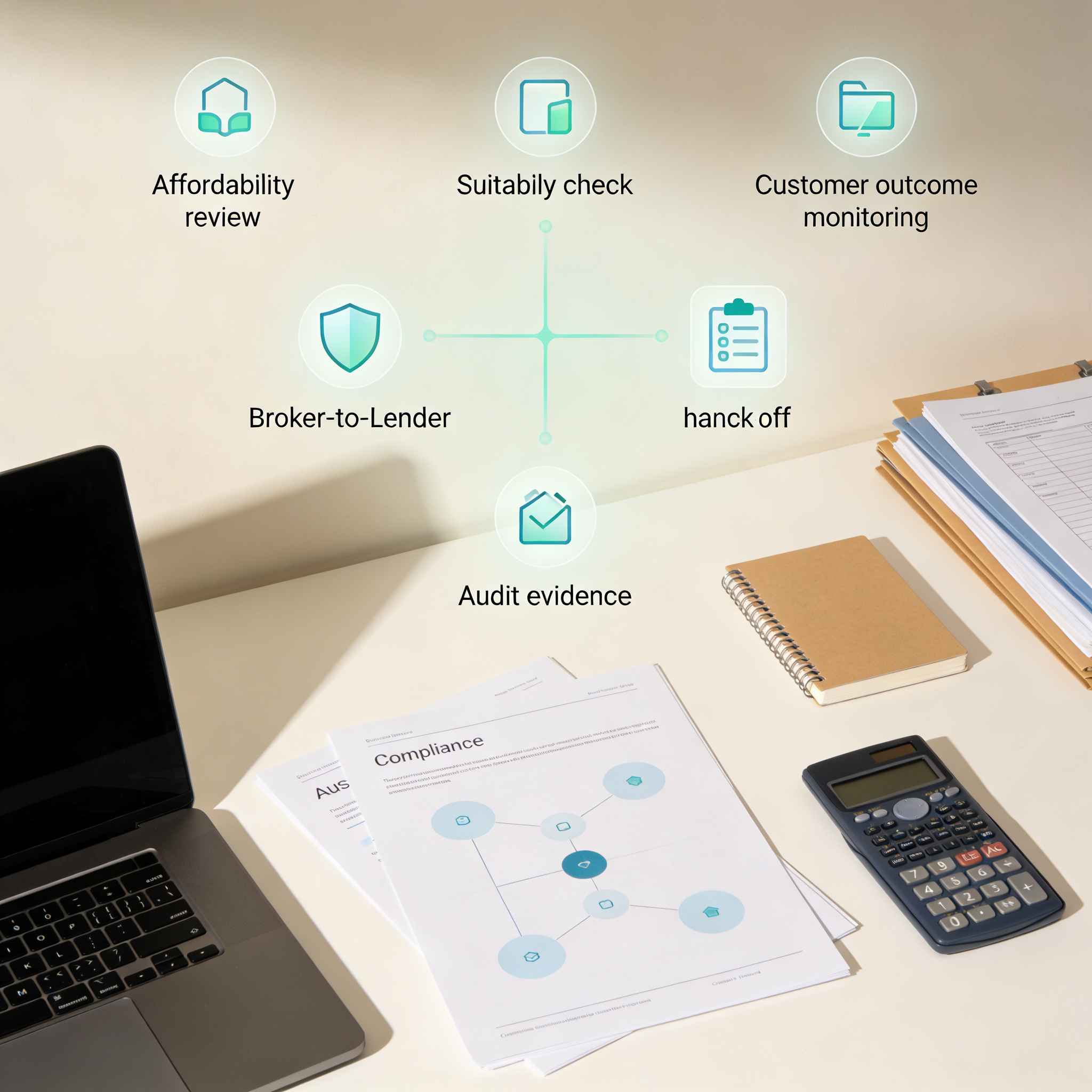
Affordability and suitability are important parts of the customer journey in consumer credit.
For credit brokers, the position needs to be understood carefully. A lender will usually be responsible for deciding whether to lend and for carrying out the required creditworthiness assessment before entering into a regulated credit agreement. However, a credit broker still has important responsibilities around the way it introduces customers, advertises credit options, explains its role, handles customer information and monitors customer outcomes.
A broker should not create unrealistic expectations, push customers toward unsuitable routes, hide important information or present finance options in a way that customers cannot understand.
This guide explains how affordability, suitability and customer outcomes fit into UK credit broking compliance.
Credit broking often sits at the start of the customer’s finance journey.
The broker may be the first firm the customer sees, the first form they complete and the first brand they associate with the finance process. That means the broker’s communications can influence what the customer understands and expects.
Affordability and suitability matter because customers need to be introduced to finance options in a way that is clear, responsible and aligned with fair outcomes.
A credit broker should consider whether:
For a broader introduction to the compliance framework, read What Is Credit Broking Compliance? A Beginner’s Guide.
Where CONC 5.2A applies, creditworthiness assessment includes both the risk that repayments will not be made when due and affordability risk to the customer. Affordability is part of that assessment. See CONC 5.2A.10R and 5.2A.12R.
The lender makes the lending decision and carries out the assessment required for its lending activity. A broker must still meet the requirements applicable to its own activities and communications; the lender's assessment does not remove those responsibilities.
A credit broker should not suggest that approval is guaranteed, that affordability checks are irrelevant, or that customers can bypass lender assessment.
For context on broker and lender roles, read Credit Broker vs Lender: Key Differences Explained.
Suitability in credit broking is often about whether the broker’s customer journey and introduction model are appropriate for the customer and the service being offered.
For example, a broker should consider whether:
A broker may not be deciding whether the customer can afford the credit. However, the broker still needs to make sure its process is not misleading, confusing or likely to result in poor outcomes.
A common mistake is assuming that because the lender makes the final credit decision, the broker has little compliance responsibility.
That is not correct.
A lender may be responsible for creditworthiness and lending decisions, but the broker is responsible for its own regulated activity and customer communications.
A broker should control:
The broker and lender may play different roles, but both should support a clear and fair customer journey.
Financial promotions can create affordability and suitability risk if they suggest that customers will be accepted regardless of circumstances.
Credit brokers should be careful with wording such as:
Promotions should be clear, fair and not misleading. They should explain the broker’s role and avoid creating unrealistic expectations about approval or suitability.
For a practical advertising guide, read How to Advertise as a Credit Broker Without Breaking FCA Rules.
A customer journey review is one of the most useful ways to identify affordability and suitability risks.
Review the journey from the customer’s perspective:
The aim is to make sure the customer is not being led into an enquiry on a misunderstanding.
For lead generation models, read Lead Generation in FCA-Compliant Credit Broking: What You Need to Know.
Consumer Duty makes customer outcomes central to credit broking compliance.
For credit brokers, this means firms should consider whether customers receive information they can understand, whether the service meets the needs of the target market, whether foreseeable harm is avoided and whether support is appropriate.
A credit broker should be able to show how it monitors outcomes, not just how it writes policies.
Useful evidence may include:
For a practical checklist, read Credit Broking Compliance Checklist: What You Need to Know.
Affordability and suitability issues can be more serious where vulnerable customers are involved.
Credit brokers should consider whether the customer journey helps identify and support customers who may need additional care.
This may include reviewing:
The aim is not to make assumptions about customers. It is to make sure the business has a practical way to respond when vulnerability is identified or reasonably suspected.
Lead generation can create suitability risk if customers are attracted through unclear, overly broad or misleading messaging.
Examples include:
A credit broker should review not only its own website but also third-party lead sources, affiliate pages and publisher activity.
For affiliate and publisher issues, read Are You an Affiliate Network or Publisher Facing Issues With Advertiser and Platform Sign-Off?.
Credit brokers should review whether customers understand how lender relationships work.
Where a broker receives commission or has commercial arrangements with lenders, the wording should be clear, accurate and appropriately placed.
Questions to ask include:
Use safer wording around lender relationships and avoid claims that cannot be evidenced, such as broad “whole of market” claims unless the business can support that position.
If a firm operates as an Appointed Representative or Introducer Appointed Representative, affordability and suitability considerations should be understood within the scope of the appointment.
An AR should operate within the permissions and framework set by the principal firm.
An IAR has a more limited role, usually involving introductions or distributing approved financial promotions. It should not act outside its permitted scope.
For ARs and IARs, practical controls may include:
AR and IAR arrangements should be controlled, selective and supported by proper oversight.
For more on route options, read Choosing an FCA regulatory route for your credit broking firm.
Common mistakes around affordability and suitability include:
For more examples, read Common Compliance Mistakes Credit Brokers Make and How to Avoid Them.
Credit brokers should keep evidence that supports their approach to customer outcomes and responsible introductions.
Useful records include:
Evidence is particularly important during FCA reviews, principal reviews, lender due diligence and internal audits.
For audit preparation, read Credit broker compliance audits: what to expect.
A practical improvement plan may include:
For ongoing compliance, read How to Stay Up to Date With FCA Rules and Regulations as a Credit Broker.
Authorised Compliance helps UK credit brokers build practical compliance frameworks around customer journeys, financial promotions, Consumer Duty and customer outcomes.
Our support can include:
We focus on practical credit broking compliance, not generic advice. The aim is to help firms build controlled, commercially workable models that support clear customer understanding and fair outcomes.
You can read more in How Authorised Compliance Helps Credit Brokers Stay FCA-Compliant and Choosing the Right FCA Compliance Consultant for Your Credit Broking Business.
Affordability usually refers to whether a customer can make repayments without difficulty or harm. Where CONC 5.2A applies, lenders assess affordability risk as part of creditworthiness, but credit brokers should make sure their own customer journey and promotions do not mislead customers or create unrealistic expectations.
Suitability in credit broking relates to whether the customer journey, introduction model and communications are appropriate for the customer and the service being offered. Customers should understand the broker role, lender role, next steps and any relevant commercial relationships.
Usually, the lender decides whether to lend and carries out the creditworthiness assessment. However, the broker still needs to control its own promotions, disclosures, customer journey and introductions.
Credit brokers should be very careful with guaranteed approval or acceptance claims. Promotions should be clear, fair, not misleading and consistent with the actual lender decision process.
Consumer Duty requires firms to focus on good customer outcomes. Credit brokers should consider customer understanding, support, target market, foreseeable harm, complaints and outcome monitoring.
Brokers should check whether customers understand who the broker is, what service is being provided, who makes the lending decision, whether data is shared, whether commission may be received and how to complain.
Lead sources are important because unclear or misleading affiliate, publisher or introducer activity can create customer confusion, poor-quality enquiries and compliance risk.
Yes. Authorised Compliance supports UK credit brokers with customer journey reviews, financial promotion checks, Consumer Duty assessments, lead generation reviews, audit preparation and ongoing compliance support.
Affordability and suitability in credit broking are not only lender issues.
While lenders usually carry out the creditworthiness assessment, brokers play an important role in shaping the customer journey before the customer reaches the lender.
A credit broker should make sure its promotions, disclosures, lead generation activity and customer communications are clear, accurate and designed around fair customer outcomes. Strong controls in these areas help reduce complaints, improve customer understanding and support a more robust compliance framework.
Check the current requirements against the activity, customer, agreement and permissions of the particular firm. These primary sources support a scope and control review; a generic checklist does not establish compliance in every model.

I’m Will Hurst, and I bring 20+ years of hands-on experience across credit broking, AR/IAR oversight, lender relationships and regulated finance operations.
Learn more about my practical, FCA-focused approach
Specialist compliance support for UK credit brokers, Appointed Representatives and Introducer Appointed Representatives. We help firms build practical, FCA-aligned compliance frameworks covering customer journeys, financial promotions, AR/IAR oversight, Consumer Duty, complaints, monitoring and regulatory applications.
Services
FCA application supportAR and IAR supportCredit broker complianceWebsite and financial promotion reviewsConsumer Duty supportCompliance monitoringComplaints and customer outcome reviewsRegulatory remediation supportMeta advertising supportAuthRouteLead generators, affiliates & publishersUseful links
HomeCredit Broker ComplianceAR & IAR SupportInsightsContactPrivacy PolicyCookie PolicyComplaints ProcedureTerms of BusinessContact
Email: support@authorisedcompliance.com
Office address: Atlantic Business Centre, Atlantic Street, Broadheath, Altrincham, England, WA14 5NQ
Registered office: Atlantic Business Centre, Atlantic Street, Broadheath, Altrincham, England, WA14 5NQ
Authorised Compliance Ltd is a company incorporated in England and Wales with registered company number 15833435.
Authorised Compliance Ltd is authorised and regulated by the Financial Conduct Authority under Firm Reference Number 1025416.
Registered with the Information Commissioner’s Office under reference ZB802407.