
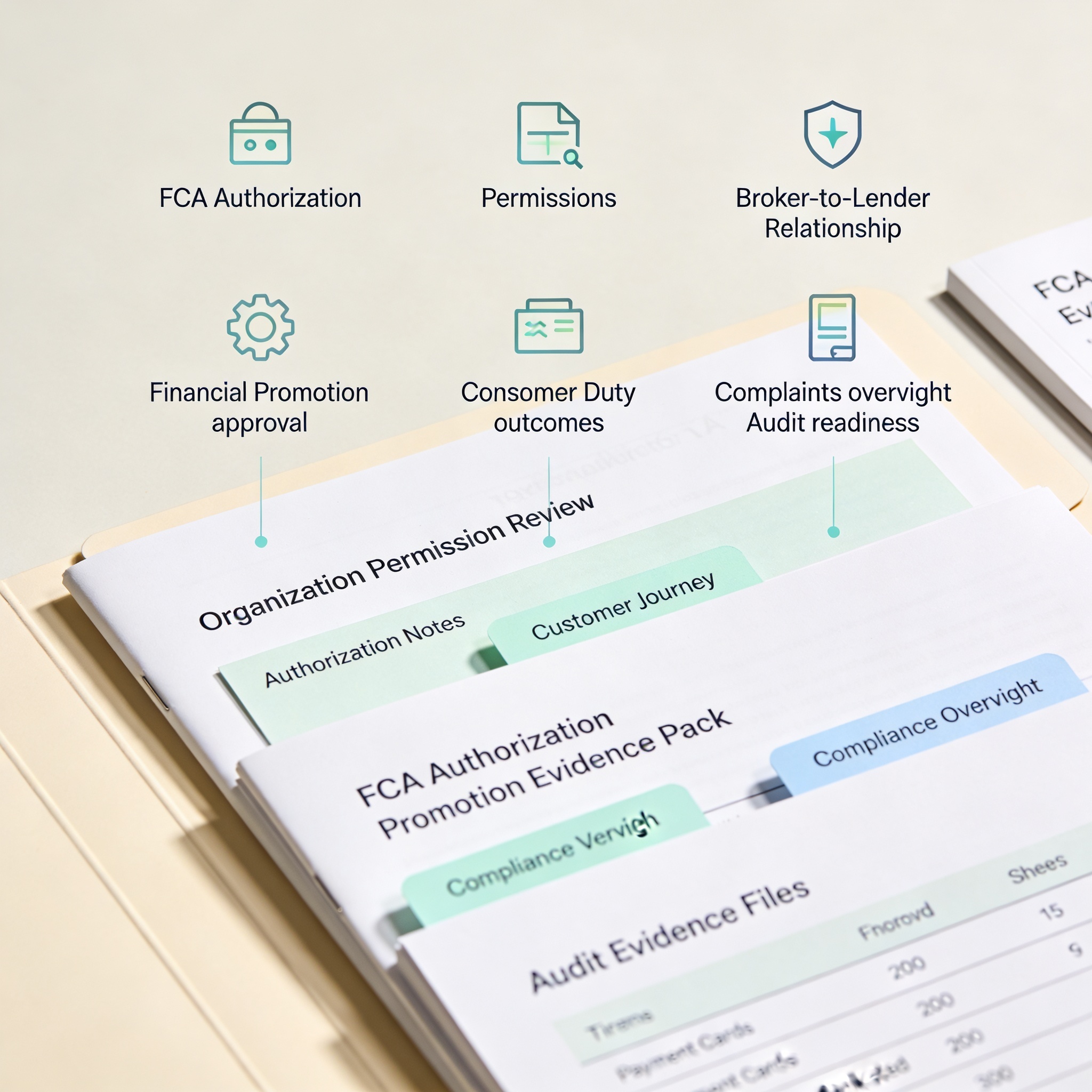
FCA authorisation means your business has permission from the Financial Conduct Authority to carry out specific regulated activities.
For credit brokers, this can be an important commercial and regulatory milestone. It can help the firm operate with clearer permissions, build lender and partner confidence, and demonstrate that the business has considered its FCA obligations.
However, authorisation is not the end of compliance. It is the beginning of an ongoing responsibility to operate within permissions, control financial promotions, monitor customer outcomes, handle complaints properly and keep evidence of compliance.
This guide explains what FCA authorisation means for a UK credit broking business and what firms need to understand after approval.
FCA authorisation means the firm is authorised to carry out specific regulated activities within the scope of its permissions.
For a credit broker, this may include permission to carry out credit broking activity. The exact position depends on the permissions granted and the business model.
Authorisation can affect how the firm:
Authorisation should be understood as permission to operate within a defined framework, not as a general approval for any future credit-related activity.
For a broader route overview, read FCA Authorisation Routes for Credit Brokers: Direct Authorisation, AR and IAR Status.
FCA authorisation does not mean the business can do anything in the credit market.
It does not automatically mean:
Authorisation gives the firm a regulatory route, but the firm still needs to operate properly within that route.
For common issues, read Common Compliance Mistakes Credit Brokers Make and How to Avoid Them.
Permissions define what the firm is authorised to do.
A credit broker should understand:
Permissions should be reviewed when the business changes.
For example, new lenders, new products, new lead sources, new customer journeys or new marketing channels may require compliance review before launch.
For application guidance, read How to Get FCA Authorisation as a Credit Broker: Step-by-Step Guide.
Authorisation does not remove the need to explain the broker role clearly.
Customers should understand whether they are dealing with a broker or a lender.
A credit broker should make its role clear across:
The FCA expects credit brokers to make clear in advertising when they are brokers and not lenders. This is especially important if the customer journey could otherwise make the firm appear to be the lender.
For a detailed explanation, read Credit Broker vs Lender: Key Differences Explained.
Once authorised, a credit broker still needs to control financial promotions.
Financial promotions may include:
Promotions should be clear, fair and not misleading. They should accurately describe the service, make broker status clear where relevant and avoid claims that cannot be evidenced.
Common issues include:
Authorised firms should have a process for approving, recording and monitoring promotions.
For more detail, read How to Advertise as a Credit Broker Without Breaking FCA Rules.
FCA authorisation should be reflected in the customer journey.
A credit broker should review the full journey from first contact to outcome.
This may include:
The customer should understand who they are dealing with, what service is being provided, who may receive their details, who makes the lending decision and how to complain.
A clear customer journey supports both regulatory compliance and better customer outcomes.
For customer journey and lead generation issues, read Lead Generation in FCA-Compliant Credit Broking: What You Need to Know.
FCA authorisation brings ongoing expectations around customer outcomes.
Under Consumer Duty, firms should act to deliver good outcomes for retail customers. For credit brokers, this means the firm should be able to show how customers understand the service and how the business monitors whether the journey is working properly.
Consumer Duty evidence may include:
A Consumer Duty policy alone is not enough. The firm should be able to evidence what it monitors and what it does when issues are found.
For related guidance, read Understanding the Affordability and Suitability Rules in Credit Broking.
FCA authorisation can support lender and partner confidence, but it does not replace due diligence.
Lenders, platforms, affiliates and commercial partners may still ask about:
Credit brokers should be ready to evidence how they manage these areas.
Use careful, evidence-led wording around lender relationships and avoid broad claims that cannot be supported.
Credit brokers should review how commission and commercial arrangements are explained.
Customers may need to understand whether the broker receives commission or other commercial benefit from lenders or finance providers.
Review whether:
Commission and lender relationship wording should be reviewed when commercial arrangements change.
Authorised credit brokers need a practical complaints process.
This should cover:
Complaints may reveal issues with advertising, broker status, lead generation, data sharing, lender handoffs, commission wording or customer support.
A good complaints process helps the firm improve the business, not just close individual cases.
Authorised firms should consider how vulnerable customers are identified and supported.
Credit brokers should review:
The process should be practical and understood by staff.
If a credit broker uses lead generation, authorisation does not remove the need for oversight.
The firm should review:
The firm should know where leads come from and what customers were told before they entered the journey.
For affiliate and publisher models, read Are You an Affiliate Network or Publisher Facing Issues With Advertiser and Platform Sign-Off?.
Authorised firms may have FCA reporting obligations.
Credit brokers should maintain a compliance calendar covering:
The business should know who is responsible for each task and keep evidence of completion.
For ongoing compliance costs, read How Much Does It Cost to Maintain FCA Compliance for Credit Brokers?.
Authorisation means the firm should be ready to evidence its compliance framework.
Useful evidence includes:
Audits should test whether the firm is operating in the way its policies and permissions say it should.
For audit guidance, read What to Expect During an FCA Compliance Audit as a Credit Broker and How to Successfully Pass FCA Regulatory Checks for Credit Broking.
FCA authorisation affects day-to-day business operations.
It may affect:
Compliance should therefore be part of operational decision-making, not something reviewed after changes go live.
For more detail, read How FCA Broker Requirements Impact Your Business Operations.
Common misunderstandings include:
FCA authorisation is important, but it must be supported by ongoing compliance.
Authorised Compliance supports UK credit brokers before, during and after FCA authorisation.
Our support can include:
We focus on practical credit broking compliance. The aim is to help firms understand what authorisation means in real operational terms and build a framework that supports controlled growth.
You can read more in How Authorised Compliance Helps Credit Brokers Stay FCA-Compliant.
FCA authorisation means the firm has permission to carry out specific regulated activities within the scope of its permissions. For credit brokers, this may include credit broking activity, but the firm still needs ongoing compliance controls.
No. Authorisation depends on the permissions granted. A credit broker should not imply that it is a lender unless it has the correct permissions and is actually acting as a lender.
No. Authorisation is only the start. Credit brokers still need financial promotion controls, customer journey reviews, complaints handling, Consumer Duty evidence, monitoring and audit records.
Advertising and financial promotions should be clear, fair and not misleading. Credit brokers should make broker status clear and avoid unsupported or misleading claims.
Yes. Authorised credit brokers should be able to show how they monitor customer understanding, customer support, complaints, lead quality and customer outcomes.
It can support lender and partner confidence, but lenders may still carry out due diligence on permissions, customer journeys, promotions, complaints and compliance evidence.
The firm should review whether its permissions, customer journey, promotions, lender relationships and compliance framework still fit the new model.
Yes. Authorised Compliance supports UK credit brokers with FCA applications, ongoing compliance, financial promotion reviews, customer journey testing, audits, Consumer Duty assessments and outsourced compliance.
FCA authorisation is an important step for a credit broking business, but it is not the whole compliance framework.
Authorisation means the firm has a regulatory route for specific activities. The firm still needs to operate within its permissions, explain its broker role clearly, control financial promotions, monitor customer outcomes, handle complaints properly and keep evidence.
The strongest credit brokers treat authorisation as a foundation for controlled growth, not as a one-time approval.
Check the current requirements against the activity, customer, agreement and permissions of the particular firm. These primary sources support a scope and control review; a generic checklist does not establish compliance in every model.

I’m Will Hurst, and I bring 20+ years of hands-on experience across credit broking, AR/IAR oversight, lender relationships and regulated finance operations.
Learn more about my practical, FCA-focused approach
Specialist compliance support for UK credit brokers, Appointed Representatives and Introducer Appointed Representatives. We help firms build practical, FCA-aligned compliance frameworks covering customer journeys, financial promotions, AR/IAR oversight, Consumer Duty, complaints, monitoring and regulatory applications.
Services
FCA application supportAR and IAR supportCredit broker complianceWebsite and financial promotion reviewsConsumer Duty supportCompliance monitoringComplaints and customer outcome reviewsRegulatory remediation supportMeta advertising supportAuthRouteLead generators, affiliates & publishersUseful links
HomeCredit Broker ComplianceAR & IAR SupportInsightsContactPrivacy PolicyCookie PolicyComplaints ProcedureTerms of BusinessContact
Email: support@authorisedcompliance.com
Office address: Atlantic Business Centre, Atlantic Street, Broadheath, Altrincham, England, WA14 5NQ
Registered office: Atlantic Business Centre, Atlantic Street, Broadheath, Altrincham, England, WA14 5NQ
Authorised Compliance Ltd is a company incorporated in England and Wales with registered company number 15833435.
Authorised Compliance Ltd is authorised and regulated by the Financial Conduct Authority under Firm Reference Number 1025416.
Registered with the Information Commissioner’s Office under reference ZB802407.